Technology & Architecture

Microservice Architecture for Insurance

Contact Us to Learn More

Insurance technology has greatly evolved in recent years. With the now widely accepted use of microservice architecture and use of APIs, Insurance Carriers and MGAs can have the technical foundation they need to support and extend their diverse and complex insurance products.

Insurance technology is becoming granular.

Insurance Carriers, Managing General Agencies, and Program Administrators are no longer constrained by using one monolithic technology platform for their insurance administrative needs. They can now easily create unique cloud-based API-centric technology platforms and customer ecosystems that simplify the management of their distribution partners and customers as well as the purchasing and administration of their insurance policies.

This new “API” approach to technology provides nimbleness, decreased costs, reduced time to market, and provides unlimited opportunities for new revenue and distribution channels.

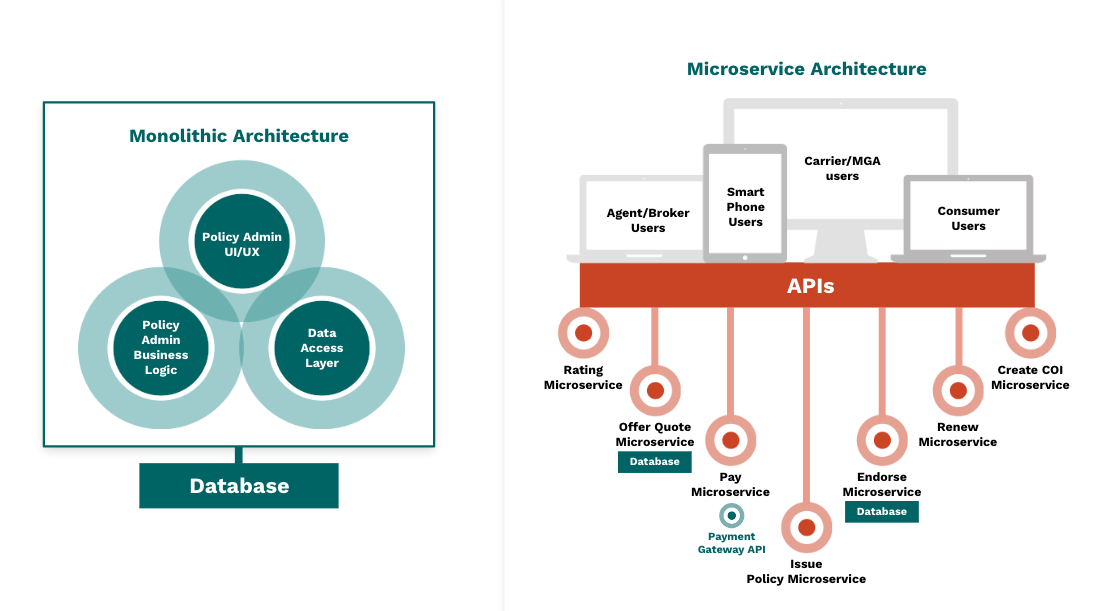
Policy Administration: Monolithic versus Solartis Microservices

With Solartis Insure, your company can break down monolithic policy administration processes into discrete services, accelerating initial development and maintenance efforts will improve the entire policy administration user experience.

Access Solartis Microservices on any device (i.e., laptop, iPad, iPhone, Chatbot) through Solartis provided screens or through API calls from your technology platform.

Monolithic V Microservices graphic

Benefits of Microservices

Get to market quicker

Solartis Insure microservices enable insurers to launch insurance products twice as fast compared to traditional insurance software deployments. Microservices easily integrate with APIs from other industries and can easily be combined and configured to meet specific business needs.

Build better insurance products

Traditional policy administration software comes with a hidden price tag: the inability to rapidly respond to new and innovative product offerings and distribution channels. A microservices architecture provides custom product options and extends your reach to other distribution channels to generate business at the point of need.

Optimize speed and performance

Solartis customers have increased the speed of their customer-facing applications by up to 100%. A microservices architecture like Solartis Insure is the foundation for a high-performing insurance business process. Microservices are independently deployable and modular.

Still not sure how Solartis microservices can help?

Contact a member of our team.

Technology and Architecture | Frequently Asked Questions

What is the technology stack behind the Solartis Insure platform?

The Solartis Insure platform is built on a modern, cloud-native technology stack designed for scalability, flexibility, and performance. Key components include: 

  • Platform & Application Layer – Java EE 7, JBoss EAP 7.x Cluster, JBOSS DROOLS rules engine 
  • UI/UX – ReactJS, JSF/Facelets, AngularJS 
  • Web Services – RESTful APIs, XML, JSON 
  • Document Generation & Management – Aspose/DocX, XSL-FO, FOP, iText, and Alfresco 
  • AI & Automation – Google Gemini 2.5 Pro, OpenAI GPT-4, Apache Airflow, Kettle 
  • Messaging & Orchestration – Apache ActiveMQ, Apache Kafka, Apache Camel • Databases – MySQL Enterprise 8.x, MongoDB, RDBMS & NoSQL with Debezium for CDC 
  • Analytics & Reporting – Apache Superset, Pentaho 
  • Deployment & Infrastructure – Oracle Cloud Infrastructure, Azure, OpenStack, Kubernetes, Jenkins 
  • Observability – Grafana for monitoring and insights 

This stack ensures a secure, extensible, and future-ready foundation for insurance policy administration.

Where is Solartis Insure hosted?

Solartis Insure is hosted on Oracle Cloud Infrastructure (OCI) which provides the latest hardware and networking technology. While we have experience with other cloud vendors such as Azure and AWS, we selected Oracle Cloud because it delivers performance, availability, and scalability aligned with our platform needs.

Do you offer a SaaS/cloud, on-premise solution, or both?

Solartis offers a SaaS/cloud solution for the Solartis Insure platform. Solartis does not offer an on-premise solution, as we focus on delivering a scalable, secure, and efficient cloud-native platform.

What API coverage does the Solartis Insure platform provide?

The Solartis Insure platform is built on a cloud-native, microservice architecture, with every functional component exposed through RESTful APIs. These APIs are stateless, loosely coupled, and designed for real-time integration with external systems such as portals, billing, claims, CRM, and data lakes.


We provide comprehensive API coverage across the full policy lifecycle, including rating, quoting and binding, issuance, endorsements (mid-term and out-of-sequence), cancellations and reinstatements, renewals, audits, forms and document generation, policy retrieval and search, and reporting and transactions.


All APIs are documented using OpenAPI 3.0 (Swagger) with detailed specifications, payload structures, and test environments. Detailed documentation can be shared during the evaluation process.

What type of data model does the Solartis Insure platform use?

The Solartis Insure platform uses a hybrid data model that combines relational and NoSQL databases to balance structure, flexibility, and scalability. MySQL Enterprise 8.x supports core policy administration with consistent, high-performance relational data, while MongoDB manages flexible, document-oriented data across lines of business. All APIs use JSON for seamless integration, and customer data is protected through a multi-tenant model with single-tenant data isolation.

How does Solartis support data integration and extractability?

The Solartis Insure platform supports both real-time and batch data extraction through REST APIs, event streaming, change data capture (CDC), scheduled calls, and flat file exports. Customers can also use Solartis Explore for bulk analysis, “what-if” modeling, and policy migrations, as well as Solartis Reporter for scheduled or ad hoc reporting. Schema documentation is provided to integrate seamlessly with BI tools, reporting environments, and data lakes.

Tell us about Solartis Insure’s mobile capabilities. Are you mobile native or mobile-responsive?

The Solartis Insure user interface is built on a ReactJS framework, which is inherently mobile-responsive. This means all screens configured in the Solartis Builder are automatically optimized for use on desktops, tablets, and mobile devices without requiring separate development. Customers also have the flexibility to design their own mobile experiences—or integrate Solartis APIs into native mobile apps—if a custom mobile-first approach is preferred.

Which browsers are compatible with the Solartis Insure platform?

The Solartis Insure platform is compatible with the latest versions of all major web browsers, including Google Chrome, Mozilla Firefox, Microsoft Edge, and Apple Safari. We also support any modern browser that supports HTML5.

What disaster recovery measures are in place for the Solartis SaaS solution?

The Solartis Insure platform is proactively monitored 24/7, 365 days a year by dedicated infrastructure, application, and business support teams. Robust monitoring tools ensure uptime, performance, and reliability across all environments.


Solartis also maintains a comprehensive disaster recovery plan to protect customer data and ensure rapid recovery in the event of an outage. Our infrastructure monitoring team manages all platform components, including virtual machines, networks, security, and storage. In the event of a failure, systems are designed to fail over to backup infrastructure, minimizing downtime and data loss.