

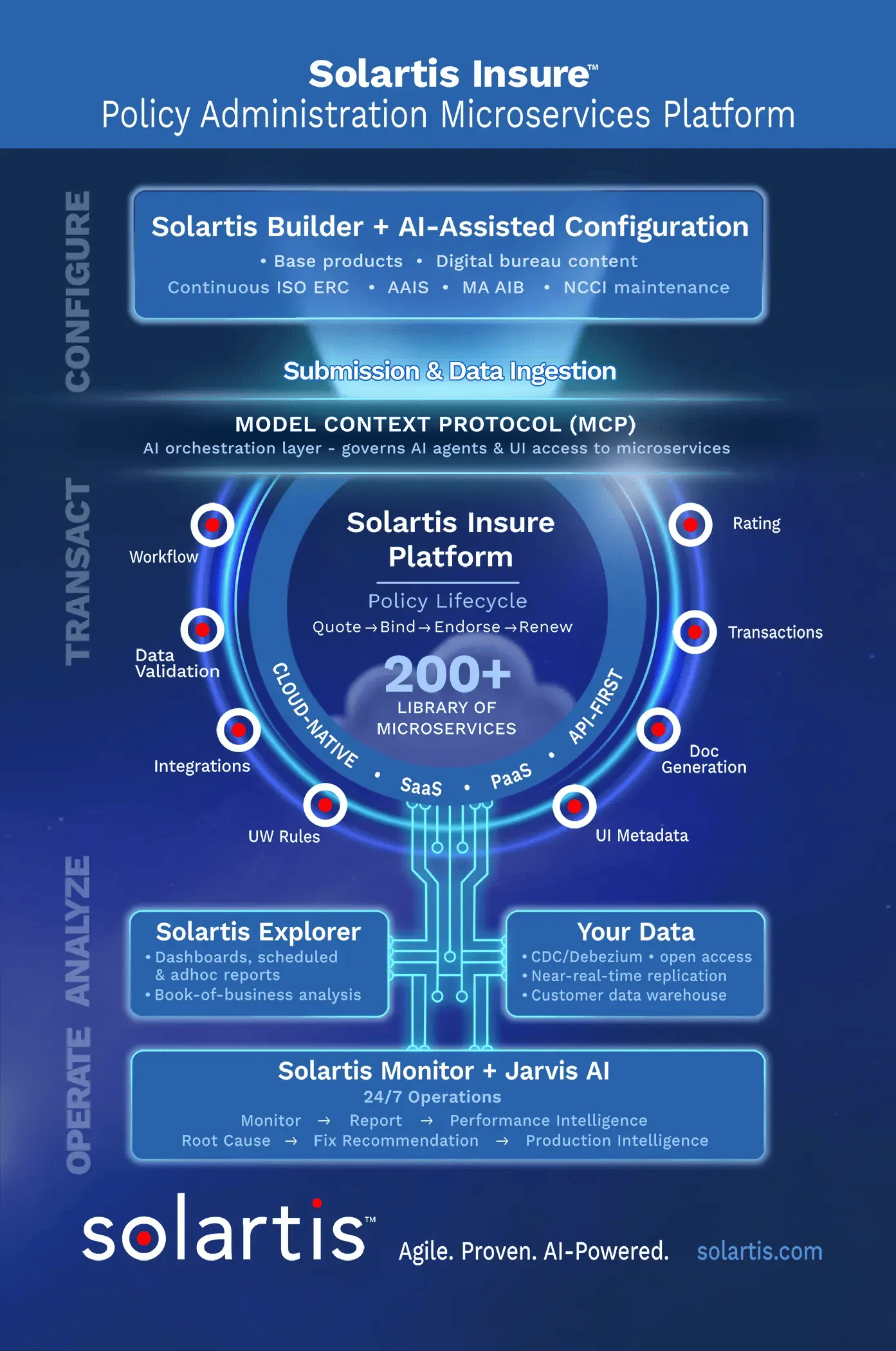
Solartis Builder is the no-code toolkit where your lines of business and programs are configured, maintained, tested, and promoted to production.
Configuration starts with a Solartis Base Product that already includes the full policy lifecycle and the bureau content you need. AI assists the ingestion and validation of AAIS, NCCI, and MA AIB (Mass Auto) rating content and state filings, while ISO rating content and circular updates are consumed electronically and directly through ISO ERC. From there, we use Builder and AI to configure your carrier-specific exceptions and deviations, and AI creates and runs the test cases that confirm each configuration before it moves to production.
For a highly unique product, you can skip the Base Product and build from scratch in Builder.
The full policy lifecycle, across 200+ microservices Submissions and data flow into the platform, which runs the full policy lifecycle (rate, quote, bind, issue, endorse, renew, cancel, reinstate) across 200+ microservices. The platform is cloud-native, delivered as SaaS and PaaS, and API-first.
Our microservices are headless, with no User Interface (screens) of their own, which means you can access them in whatever way suits you. Call any or all of our policy lifecycle services from your own user interface through a simple JSON request and response. Configure your own screens in Solartis Builder using our metadata microservice. Or, for a chatbot-style interface, reach those same APIs through our Model Context Protocol (MCP), a governed AI layer that orchestrates our APIs to issue policy transactions and query your policy data through question prompts, instead of driving through screens.
Solartis Explorer provides reporting and dashboards across all platform data, including scheduled and ad-hoc reports, plus book-of-business "what-if" analysis, aggregate management, and bulk policy or account migration.
Your data stays yours and stays open. Solartis provides a near-real-time replicated database, plus the schema, containing your policy transactions, user activity, imported data, and more, so you can use your data anywhere you want. Build custom reports with your preferred BI tools, feed downstream systems or your own data warehouse or data lake, and run your own analytics, with no dependence on us to reach your own information.
Once your lines of business and programs are in production, Solartis keeps them running around the clock on Oracle Cloud Infrastructure, tools and people working together.
Solartis Monitor and Jarvis AI provide AI-assisted observability, continuously watching performance, capacity, services, and system health. When an issue surfaces, Jarvis helps identify the likely root cause and recommends corrective action, reducing the time to diagnose and resolve.
Our Monitoring Specialists work alongside the tools around the clock, reviewing what the AI surfaces, validating its recommendations, and taking action within defined response and resolution targets by severity.
Human in the Loop: AI recommends. People review and approve before changes are made.

Solartis Insure is a cloud-native, microservices-based policy administration platform built for flexibility, scalability, and speed to market. It is composed of more than 200 stateless API microservices covering the entire policy lifecycle — rating, quoting, issuance, endorsements, cancellations, reinstatements, renewals, and more. Each microservice can be used independently or orchestrated together, allowing customers to deploy only the services they need.
Solartis microservices can be consumed in your technology platform via API calls or through a Solartis-generated UI/UX, which is dynamically created using our metadata microservice.
Paired with the Solartis Builder low-code toolkit, business analysts and IT teams can configure and maintain all aspects of their insurance products — including carriers, states, coverages, rating content, policy documents and forms, UI/UX screen pages and their questions, and eligibility, underwriting, and referral rules. Builder also supports testing at both the microservice and product level and seamless deployment from DEV → TEST → LIVE without heavy IT reliance.
The platform supports personal, commercial, admitted, and E&S programs, including both ISO/AAIS-based products and proprietary specialty programs.
Yes, Solartis Insure can be delivered in multiple ways to fit different modernization strategies. Customers can deploy the platform as a full end-to-end PAS, adopt individual microservices (such as rating or document generation) while retaining their own ecosystem components, or use a coexistence model where Solartis microservices run alongside legacy PAS platforms. This flexibility allows carriers and MGAs to align Solartis Insure with their IT strategy, budget, and roadmap.
Solartis Insure comes with a full ecosystem of supporting components designed to reduce time-to-market, ensure compliance, and provide actionable insights:
AMT (Application Monitoring Tool) – 24/7 monitoring and support that proactively detects issues and provides real-time visibility.
The Solartis pricing model is a subscription-based model that is flexible, scalable, and affordable, designed to grow with your business. It includes an annual license fee based on the number of lines of business, plus a tiered usage fee based on an agreed measure. Initial implementation is priced according to the scope and complexity of your products, while ongoing maintenance is managed directly by you in Solartis Builder at no additional cost.
The subscription fee is all-inclusive, covering the technology, infrastructure, and services required to run and maintain the Solartis platform:
If you use the Solartis platform for the full policy lifecycle, each Solartis microservice operates as a stateful, lightweight service. They work together through API orchestration configured in the Builder Toolkit. For example:
Solartis Builder acts as the central control point, ensuring consistent configuration across rating, rules, UI, workflows, and documents. In addition, our modular architecture allows Solartis microservices to be used as independently deployable services (via API calls) embedded within your tech platform/ecosystem.
Solartis Insure supports a wide range of personal, commercial, admitted, and E&S insurance products, including Personal Property Programs, Commercial Auto, General Liability, Excess, Inland Marine, Commercial Property, and specialty programs.
Carriers can start with Base Products preloaded with ISO/AAIS content and prebuilt workflows, forms, and UI, or configure entirely custom products for niche programs. The platform consumes ISO Commercial Lines content and updates directly, ensuring access to the latest circulars, rules, rates, forms, and statistical codes.
Using the Solartis Builder toolkit, Solartis consumes ISO Commercial Lines rating content — including countrywide and state circulars, rating content, form selection rules, and statistical codes — directly into the platform. Solartis also supports countrywide rating, multiple carriers, and surplus lines taxes and fees for all states.
All circular updates are available in the platform and can be adopted based on either the circular effective date or the carrier’s adoption date, with all previous versions maintained to support historical and in-force policy transactions. Within Builder, carrier exceptions and deviations to ISO are maintained in a separate layer, ensuring easy coexistence with the pure ISO base content.
Yes. Solartis Insure supports multiple ways to input submission data, ensuring flexibility and seamless integration with existing workflows. Submissions can be imported via RPA tools, AMS/CRM integrations, ACORD or proprietary forms, third-party data providers, or bulk uploads of vehicle/property schedules. Manual entry is also supported through intuitive, configurable screens.
Yes. The Solartis platform provides standard dashboards to view and assign submissions, referrals, upcoming renewals, and other key areas. Dashboards and task lists include features such as paging, sorting, and user-based filters. Customers can also configure unique dashboards to meet their specific requirements.
Yes. The Solartis platform allows users to create tasks, add attachments, send emails, and add comments or notes directly on a quote or policy record.
The Solartis platform provides extensive search capabilities across insureds, submissions, quotes, policies, and all policy transactions. Flexible filters allow users to refine results by customer name, submission number, bind request, creation date, transaction date ranges, and more.
Yes. Solartis includes a Subjectivity Module that lets carriers configure, track, and resolve all required activities and documents before a policy can be bound or issued. Subjectivity rules are configured and maintained in Solartis Builder, and can be triggered automatically by product type, coverages or underwriting conditions.
Underwriters can also create manuscript subjectivities on an individual policy basis. The module provides tracking, reminders, and audit trails to ensure compliance and timely resolution, moving policies seamlessly into binding or issuance once subjectivities are satisfied.
Yes. The Solartis platform fully supports the import and processing of large policy schedules, including commercial auto policies with 15,000+ vehicles, as well as property schedules with multiple locations, buildings, and personal or commercial itemized property schedules across all 50 states.
Robust import tools validate data during upload — for example, in Commercial Auto, the system performs VIN checks, auto-renumbering, and required field validation — and generates detailed reports to quickly identify and correct errors. This ensures fast, accurate ingestion of complex schedules, making Solartis ideal for high-volume commercial policies and multi-state program business.
Yes. Solartis allows users to generate multiple quotes and display them on a single screen, providing a clear side-by-side comparison. This enables carriers, agents, and brokers to quickly evaluate options, compare coverages and premiums, and select the most appropriate policy for their customers.
Yes, Solartis fully supports out-of-sequence endorsements. Our standard process deactivates the current endorsement, inserts the out-of-sequence endorsement, and then reapplies the current endorsement with the previous endorsement changes incorporated into the policy. This ensures policy accuracy, full premium recalculation, and updated forms and documents. If a carrier follows a different process, Solartis can adjust the workflow to align with their specific requirements.
Solartis configures the renewal process according to each customer’s requirements. If the workflow requires a renewal proposal and/or binder to be generated before issuing the renewal policy, the system can be configured to follow that process. Alternatively, if no proposal or binder is required, the system can directly issue the renewal policy based on the policy’s current state at the time of renewal.
Renewals can be processed as one-offs or in batches, giving carriers flexibility in managing volume. Policies can also be flagged for underwriter review either manually or automatically through rules configured in Solartis Builder (for example, policies with more than three claims in the last three years or claims totaling over $10,000).
Yes. The Solartis platform includes a growing library of pre-built integrations across claims, billing, risk scoring, catastrophe modeling, underwriting data services (e.g., Verisk, MSB, CoreLogic), CRM platforms (e.g., Salesforce), document management, MFA, and compliance/tax solutions. Our microservices and API-first architecture enable rapid custom integrations with modern and legacy systems.
Yes, Solartis supports both Solartis-generated and customer-built portals. Our metadata-driven UI services can generate responsive, role-specific portals for agents, brokers, and customers.
Carriers may also build their own portals and call Solartis microservices through APIs. Hybrid models are common — for example, Solartis UI is used for rating screens and policy lifecycle services, while customer-built portals manage direct-to-consumer sales and policy servicing.
Solartis Report, the platform's reporting and analytics capability, provides carriers with both flexibility and actionable insight. Customers can use the reporting database and schema to directly access their data with their own BI tools or leverage the Reporter platform for dashboards, canned reports, and ad hoc reports. Together, these options deliver real-time visibility into performance and empower faster, data-driven decisions.
Yes, Solartis Insure is designed to integrate seamlessly with carrier and third-party systems. All 200+ microservices are exposed through RESTful APIs, allowing in-house systems or vendor applications to call Solartis services such as rating or document generation.
Customer-built portals can also integrate Solartis services as part of a larger ecosystem. Microservices can be used standalone, embedded, or orchestrated with carrier APIs, giving carriers and MGAs flexibility to modernize at their own pace while maintaining existing investments.
Yes. The Solartis platform supports multiple currencies, enabling seamless policy administration across regions and markets.
Yes. With Solartis Explore, carriers can perform book-of-business level changes—not just individual policy updates. Explore supports:
After a one-time setup of the Bulk Transaction Change Model, carriers can run it repeatedly and on an as-needed basis.
Migrating existing transaction data is a standard part of configuring a new product in Solartis Insure. Solartis uses Solartis Explore, an orchestration tool that transforms source data into native transactions (submissions, quotes, policies) so that migrated data functions exactly as if it had been entered directly in the system.
The process is collaborative and iterative, with Solartis working closely with customers to define required data elements, rules, and validations. Depending on needs, migrations can be performed in bulk (all at once) or scheduled in batches at set times (for example, 120 days prior to renewal). Migration may include historical policies, submissions, quotes, endorsements, or related documents.
This approach ensures migrated data is accurate, complete, and fully usable within Solartis Insure.

